Start with product classification
CPC means Children’s Product Certificate. GCC means General Certificate of Conformity. These are written compliance certificates for the applicable product, not two interchangeable laboratory approvals.
Begin with the intended user, product design, age grading, packaging and marketing. A children’s product is designed or intended primarily for children 12 years of age or younger. A mat is not automatically a children’s product just because a child might use it. Conversely, calling a puzzle playmat “general use” does not settle the classification when its design and presentation primarily target children. CPSC: Children’s products and classification.
When CPC or GCC applies
| Question | CPC | GCC |
|---|---|---|
| Product category | Children’s products subject to applicable CPSC children’s product safety requirements | General-use products subject to applicable CPSC certification requirements |
| Testing basis | Required third-party testing by a CPSC-accepted laboratory for the applicable rule, subject to relevant exceptions | Testing of each product or a reasonable testing program |
| Overseas production | The importer is responsible for issuing the certificate | The importer is responsible for issuing the certificate |
| Supplier’s report | Supports the certificate when the sample and required testing match | Supports the certificate or testing program when its scope matches |
For a regulated children’s puzzle mat, review the CPC route and required test plan. General-use EVA flooring or rubber/EVA flooring may need a GCC if a mandatory CPSC rule applies to the finished product. Not every foam mat requires a GCC, and a children’s mat does not routinely need both a CPC and a GCC for the same set of requirements. CPSC: CPC guidance; CPSC: General-use testing and certification; CPSC: Which products require a GCC.
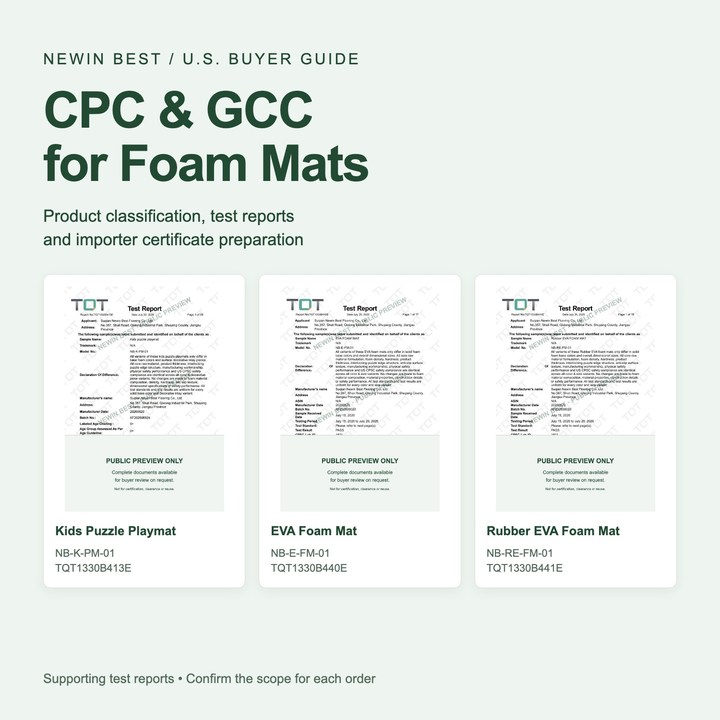
Three Newin Best supporting test reports
| Sample and model | Report | Date / pages | Original document |
|---|---|---|---|
| Kids Puzzle Playmat NB-K-PM-01 | TQT1330B413E | July 20, 2026 26 pages | Request Full Report |
| EVA Foam Mat NB-E-FM-01 | TQT1330B440E | July 20, 2026 17 pages | Request Full Report |
| Rubber EVA Foam Mat NB-RE-FM-01 | TQT1330B441E | July 20, 2026 18 pages | Request Full Report |
These original PDFs name Suqian Newin Best Flooring Co., Ltd. as the applicant/manufacturer and Shenzhen Tianqi Testing Technology Service Co., Ltd. as the laboratory. Their summaries state PASS for the listed requests. Individual test pages also contain scope qualifications and not-applicable entries; read those pages rather than treating the summary as a universal safety guarantee.
Kids puzzle playmat, NB-K-PM-01: report TQT1330B413E records tests including use and abuse, small parts, sharp points/edges, lead, phthalates, ASTM F963-23 toy safety and additional requested tests. Confirm which rules apply to the finished order and reconcile age grading with the approved warning labels.
EVA foam mat, NB-E-FM-01, and rubber EVA foam mat, NB-RE-FM-01: reports TQT1330B440E and TQT1330B441E include small-carpet/rug surface-flammability testing under 16 CFR 1631, chemical test requests and ASTM F1637-2021 walking-surface assessment. These are supporting test records; a listed test does not establish that its rule is mandatory for every foam floor tile.
The PDFs identify particular samples and stated variant declarations. Do not assume they cover every mat in the catalogue, every thickness, a different formulation, a printed/textile surface, or altered detachable pieces. Match the order’s model, construction and production records to the evidence.
Check the scope of toys, flooring and test claims
If a mat is classified as a children’s toy, the applicable toy-safety requirements and other relevant children’s product rules must be considered. For products intended for children under three, small parts and parts released after use-and-abuse testing require particular attention. A warning label is not a substitute for meeting an applicable small-parts ban. CPSC: Toy safety and small-parts requirements.
For flooring, do not infer mandatory carpet/rug classification from the word “mat” or from a report heading. CPSC’s carpet/rug definitions and size thresholds determine the relevant scope; its guidance also notes exclusions for resilient floor coverings. Buyers should have the finished construction and intended installed format reviewed before selecting 16 CFR 1630 or 1631. CPSC: Carpet and rug scope.
Additional requested tests, such as the reports’ California Proposition 65 content checks or ASTM walking-surface assessments, do not replace the applicable federal certificate rules. A content-test result alone is not a blanket conclusion about every exposure scenario, and a tested surface is not a promise of slip-free use in every installation.
Turn supporting reports into an order-specific certificate
Keep the laboratory report and the importer’s certificate as separate records. For overseas-manufactured products, the importer remains responsible for the applicable CPC or GCC even when a factory, laboratory or consultant helps assemble the information. CPSC: CPC certificate elements; CPSC: GCC responsibilities.
Prepare a record set identifying:
- The finished product, model/SKU, materials, intended use, age grading where relevant, and production batch.
- Each applicable CPSC rule being certified, with the supporting test evidence.
- The certifying importer and the contact responsible for compliance records.
- The manufacture date and place, and the test date and location.
- The required testing laboratory details for a CPC, including acceptance for the rules being tested.
- The final product and packaging labels, plus traceability information required for the category.
Check the current certificate requirements rather than leaving importer details blank in a supplier template. Review design or material changes before reusing an earlier report. For a CPC, verify the laboratory’s relevant acceptance in the official CPSC laboratory database; a lab ID printed in a report is not a substitute for checking the applicable testing scope.
U.S. eFiling: a current shipment-planning step
As of this guide’s October 14, 2026 update, CPSC’s general import eFiling requirements have been effective since July 8, 2026. Importers of consumer products subject to CPSC certification requirements must electronically file the required certificate data. The separate effective date for relevant entries from Foreign Trade Zones is January 8, 2027. CPSC: Certificate updates and effective dates.
Coordinate the product classification, current certificate content, electronic filing and shipment identifiers with the importer and customs broker before dispatch. Downloading a supplier’s PDF does not complete eFiling, and eFiling does not replace the underlying tests or certificate.
Common buyer questions
Is CPC a certificate issued by CPSC?
No. It is the responsible manufacturer’s or importer’s written certification based on the required testing. It is not a CPSC product approval.
Does one report cover every colour and size?
Only use the report within its identified sample and supported variant scope. Review formulation, construction and production changes before extending coverage.
Can I use the factory PDF as my final import certificate?
A report is supporting evidence. The responsible importer must prepare the applicable certificate with the required product, rule and contact details.
Do passing results mean the mat is fireproof or safe for all ages?
No. A result concerns the specified test and sample. Confirm the intended age group, installation, instructions and applicable product requirements.