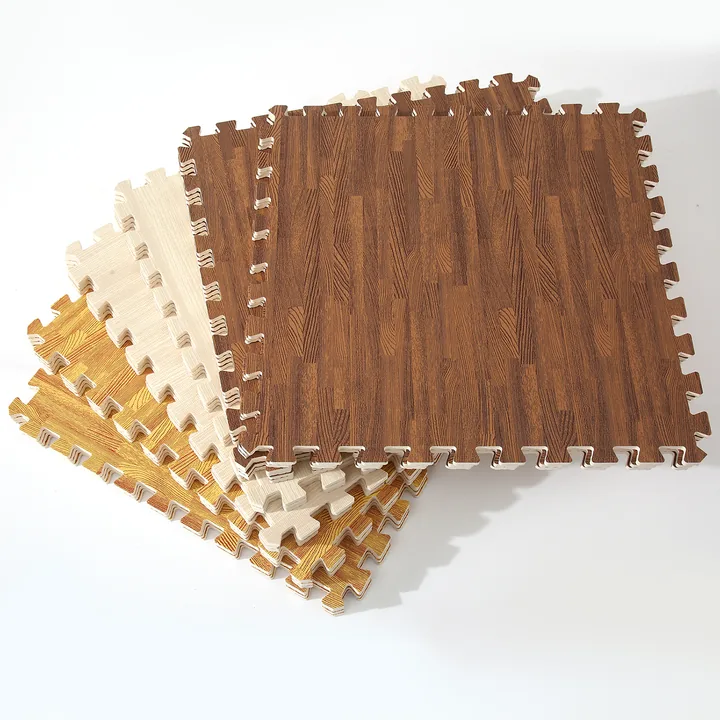
EVA vs PVC vs XPE Foam Mats: Which Material Is Right for Your Market?
When buyers source interlocking foam mats for gyms, playrooms, workshops or retail resale, the first question is usually: EVA, PVC or XPE? Each material has a distinct cost structure, performance profile and safety footprint. Picking the wrong one for your market means returns, complaints and margin erosion. This guide breaks down the three polymers side by side — density, cushioning, durability, safety certifications and price — so you can make a sourcing decision with confidence.
What each material is, chemically
EVA (Ethylene-Vinyl Acetate)
EVA is a copolymer of ethylene and vinyl acetate (VA content typically 10–40%). The higher the VA, the softer and more rubber-like the foam. EVA is produced by mixing resin with a chemical blowing agent (usually azodicarbonamide), heating under pressure, then curing and cutting. It is a closed-cell foam, so it does not absorb water and resists mold and mildew.
PVC (Polyvinyl Chloride)
PVC is a thermoplastic polymer made from vinyl chloride monomer. Flexible PVC foam mats contain plasticizers (phthalate-free grades are standard for toy and fitness applications) that give the material its pliability. PVC is denser and more rigid than EVA, with excellent abrasion resistance and oil/chemical tolerance.
XPE (Cross-Linked Polyethylene)
XPE is polyethylene foam that has been cross-linked — either by electron-beam irradiation or chemical cross-linking — before foaming. The cross-linking creates a fine, uniform cell structure that gives XPE superior thermal insulation, dimensional stability and a slightly smoother surface feel than EVA.
Side-by-side comparison
| Property | EVA Foam | PVC Foam | XPE Foam |
|---|---|---|---|
| Density | 80–200 kg/m³ | 150–300 kg/m³ | 25–100 kg/m³ |
| Weight | Light | Heavy | Ultra-light |
| Cushioning / shock absorption | Excellent | Good | Excellent |
| Surface hardness | Soft to medium | Firm | Soft |
| Water resistance | Excellent (closed-cell) | Good | Excellent (closed-cell) |
| Oil / chemical resistance | Fair | Excellent | Good |
| Abrasion resistance | Good | Excellent | Very good |
| Thermal insulation | Good | Fair | Excellent |
| Cutting / custom shaping | Easy (knife or die) | Hard (needs saw) | Easy |
| Typical safety certs | EN71, ASTM F963, CPSIA, REACH | EN71, RoHS, REACH | EN71, ASTM F963, REACH |
| Price per m² (FOB China, bulk) | $2.50–5.00 | $4.00–8.00 | $3.50–7.00 |
| Best for | Play mats, gym flooring, workshops, martial arts | Industrial anti-fatigue, heavy-duty gym zones, commercial kitchens | Camping mats, premium play mats, thermal insulation layers |
How to choose for your market
Choose EVA if you sell to…
- Parents and preschools — EVA's softness and EN71/CPSIA compliance make it the default for baby play mats and kindergarten flooring.
- Home gym owners — Lightweight tiles (≈ 0.5 kg per 60×60 cm piece) are easy to lay, lift and clean. Shock absorption protects joints during floor exercises.
- Workshops and garages — Oil-resistant top layers and interlocking edges turn any concrete floor into a comfortable standing surface.
- Retailers on tight margins — EVA offers the lowest landed cost per square meter while still carrying full safety certifications.
Choose PVC if you sell to…
- Commercial gyms with heavy equipment — Power racks, Smith machines and Olympic platforms need the density and compression resistance that PVC provides.
- Industrial workplaces — Anti-fatigue mats in assembly lines and standing-desk offices benefit from PVC's durability under 8+ hour daily use.
- Food-service and commercial kitchens — PVC's oil and grease resistance is hard to match at the price point.
Choose XPE if you sell to…
- Outdoor and camping retailers — XPE's ultra-low weight and excellent thermal insulation make it the standard for sleeping pads and tent flooring.
- Premium baby-mat brands — The finer cell structure gives a silkier surface feel that commands a higher retail price.
- Cold-climate markets — XPE retains flexibility at temperatures where EVA begins to stiffen.
Safety certifications: what to ask your supplier for
Regardless of material, every foam mat destined for consumer use should carry current test reports. Here is the checklist we provide to every NewinBest buyer:
- EN71-1/2/3 (EU toy safety — mechanical, flammability and migration of elements)
- ASTM F963 (US toy standard)
- CPSIA (US Consumer Product Safety Improvement Act — lead and phthalates)
- REACH (EU chemicals regulation — SVHC screening)
- RoHS (heavy metals and restricted substances)
- Formamide test (for EVA baby mats — EU Toy Safety Directive limit: 200 mg/kg)
A factory that can show SGS, Intertek or TÜV reports dated within the last 12 months is a strong signal of consistent production discipline. View NewinBest's full certificate portfolio.
Cost structure: why EVA wins on margin
For a standard 60 × 60 cm × 1 cm interlocking tile in bulk FOB Shanghai:
- EVA: raw resin ≈ $1.80/kg, simple foaming process, high yield → $2.50–5.00/m²
- PVC: raw resin ≈ $1.50/kg but plasticizers and denser formulation raise finished cost → $4.00–8.00/m²
- XPE: cross-linking step adds 15–25% to energy and equipment cost → $3.50–7.00/m²
These are indicative ranges. Custom colors, logo printing, printed film laminates and special textures (wood grain, tatami, suede) add $0.50–2.00/m² depending on complexity and order volume.
Need a material recommendation for your specific market?
Send us your target retail price, end-user profile and expected order volume. We will recommend the right material, thickness and surface finish — and quote a sample batch within 24 hours.